Biopunk · The Program

Twelve weeks,
one trajectory.

Biopunk is the accelerator Haus runs for early-stage biotech founders. You move in, you get a bench, and you spend ninety days turning science into a company a stranger can diligence. This is the whole program, written down.
Cohort 3
Sept 15 – Dec 12 2026
Length
12 weeks · 90 days
Location
San Francisco
Terms
$10K SAFE + 1% advisory
Apply → See the 90 days ↓
RISK MAPATGCCATTGGACCTTAAGCGREVERSE DEMO DAYATGCCATTGGACCTTAAGCGORRICK SERIESATGCCATTGGACCTTAAGCGHACKATHON SPRINTATGCCATTGGACCTTAAGCGWEEKLY DINNERSATGCCATTGGACCTTAAGCGFINAL SHOWCASEATGCCATTGGACCTTAAGCGRISK MAPATGCCATTGGACCTTAAGCGREVERSE DEMO DAYATGCCATTGGACCTTAAGCGORRICK SERIESATGCCATTGGACCTTAAGCGHACKATHON SPRINTATGCCATTGGACCTTAAGCGWEEKLY DINNERSATGCCATTGGACCTTAAGCGFINAL SHOWCASEATGCCATTGGACCTTAAGCG
01 / What Biopunk is
An accelerator that starts at the bench and ends at a data room.
Haus Ventures Fund is the investment vehicle. Biopunk Ventures is the operating company that runs the accelerator — the houses, the labs, the cohort and the curriculum. The next generation of life-science companies is being built at kitchen tables and shared benches, not inside corporate campuses, and Biopunk compresses everything an early-stage biotech founder needs into one address.
An intensive twelve weeks blending rigorous scientific work, startup building, and a culture of mutual care and ambition. Presence and participation are the deal. No lectures for their own sake and no theater — every module ends in an artefact, and the artefacts are what you leave with.
6
Curriculum tracks, from decision-making to founder life
39
Modules — 17 delivered live on the calendar, 22 worked async
22
Named deliverables the program actually asks you for
4
Orrick workshops plus standing legal office hours
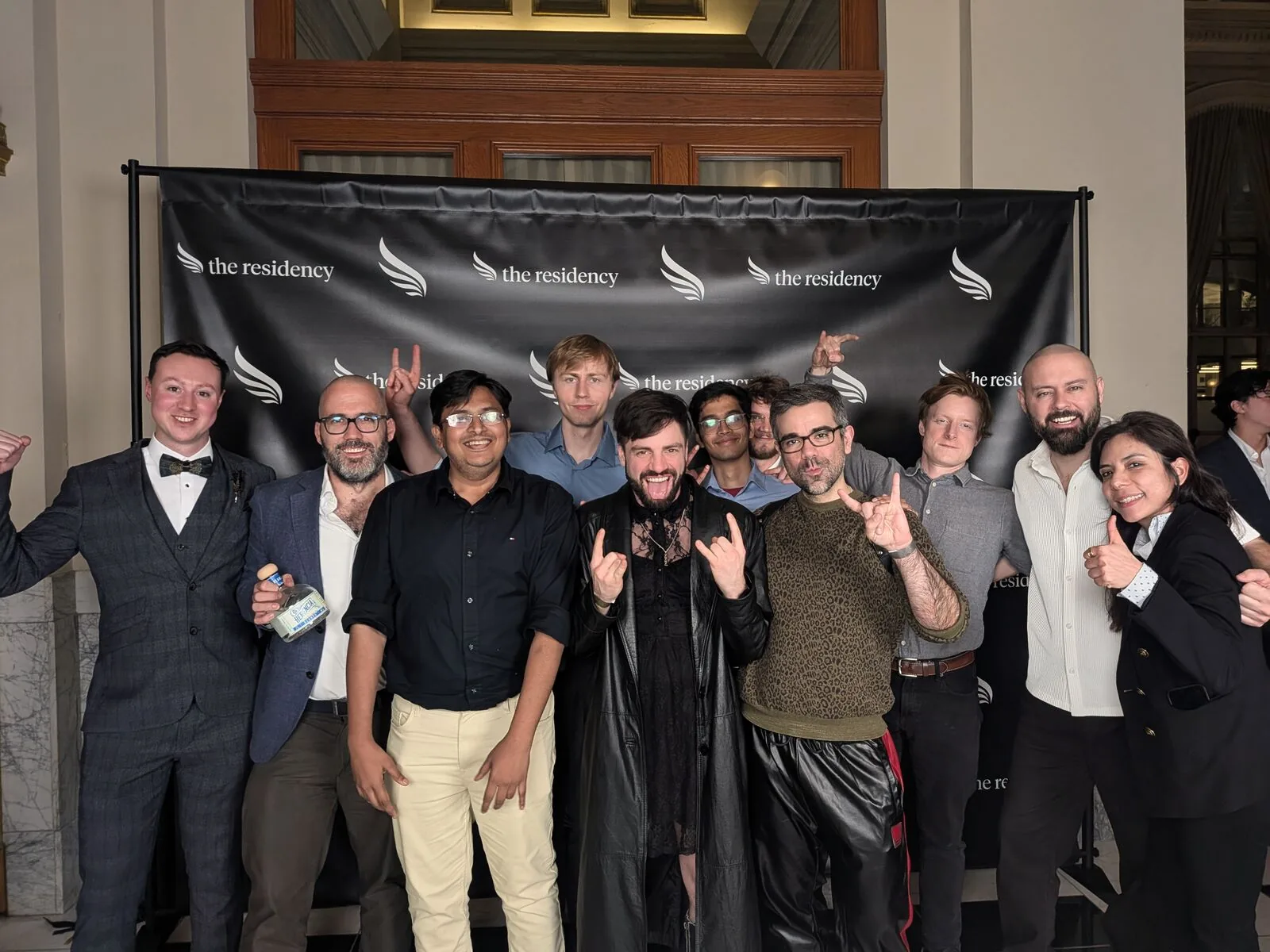
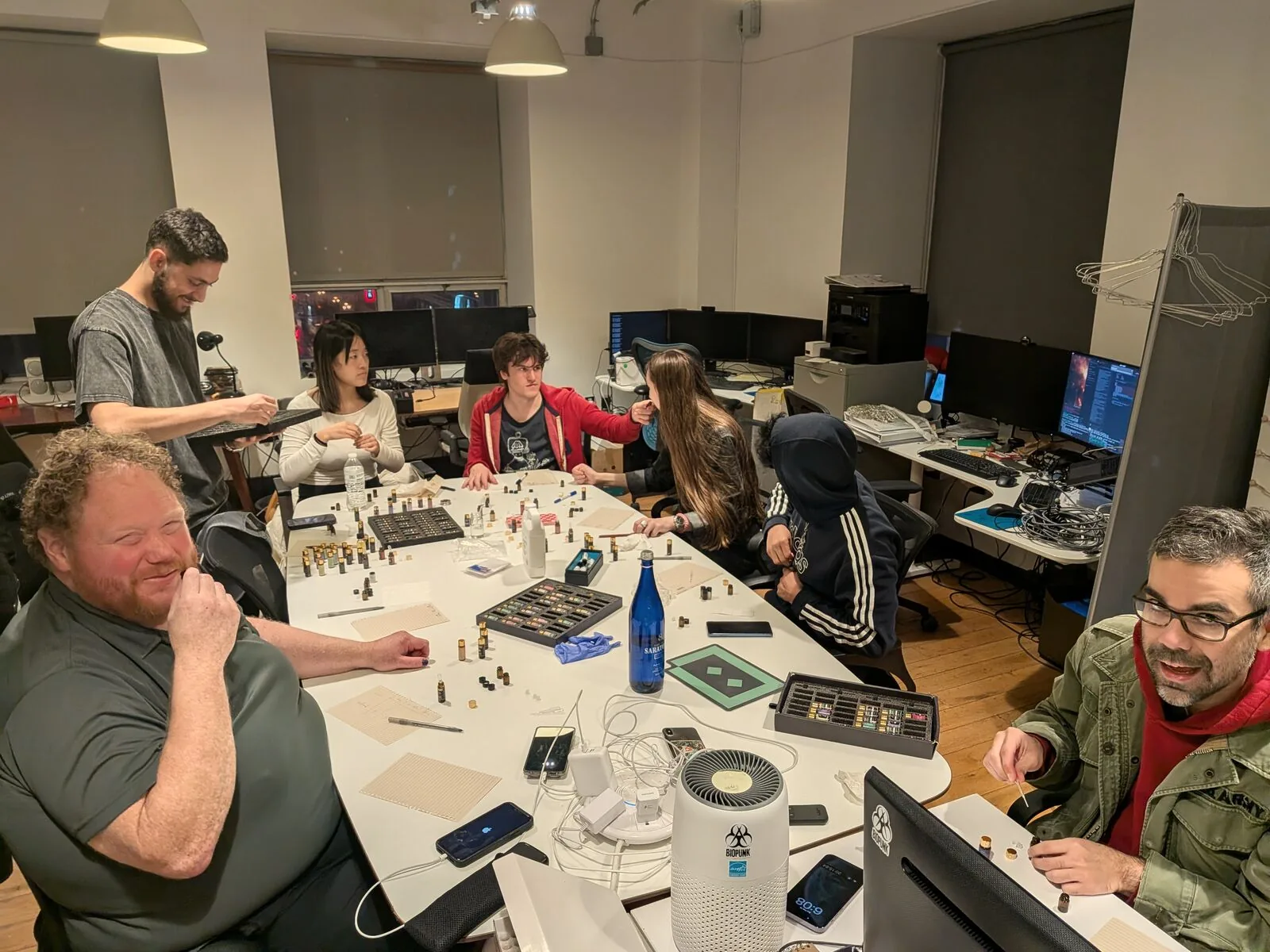
Founders around a shared worktable during a build session
02 / The deal
Nothing is taken during the residency.
The terms are stated plainly at orientation because founders should not have to ask. They are stated here for the same reason.
Investment
$10K SAFE
Haus Fund I invests on completion of the program, not on arrival. First checks into standout cohort teams follow separately, on their own terms.
Equity
1% advisory
Granted post-program under the resident agreement. Orrick 3 covers the instrument itself, and residents are told to confirm it with counsel rather than take our word for it.
During the 12 weeks
Nothing
No equity is taken while you are in residence. Housing, bench access, the Orrick series, weekly dinners and office hours are the program, not a purchase.
What is asked of you instead
Presence and participation. You live in the house for the full program, you show up to the weekly dinner, you log the deliverable against each module, and you answer the Sunday check-in honestly — especially the procrastination question. The cohort is the asset, and it only works if everyone is actually in the room.
03 / The arc
Four phases and one constant.
The shape of every cohort. The calendar underneath it changes; this does not.
Phase_01
Orient
Week 1
Orientation
Move in, meet your cohort, map your science to a buildable company. Lab onboarding, biosafety clearance, program expectations, community norms, the ecosystem map, office-hours structure, and a working hypothesis you will be held to.
Phase_02
Diligence
Investors pitch you
Diligence prep → Reverse Demo Day
Build the data room before anyone asks for it: science, IP, market, team. Then the tables turn — at Reverse Demo Day the investors pitch the founders on why they deserve a seat on your cap table.
Phase_03
Build
Ship something
Hackathon sprint
Heads-down execution: experiments at the bench, customers on the phone, weekly demos to the house. The sprint forces a shippable artefact out of every team, and week 8 carries no workshop so that it can.
Phase_04
Showcase
The finale
Final immersive showcase
Not a pitch night — an immersive demonstration of your company, your data and your raise, staged for investors, partners and press. Then: the alumni network, ongoing community, and extended stays for breakout projects. See the showcase brief →
Constant
Ritual
Every week
Weekly dinners
Every week, the whole house at one table. The cross-pollination engine of the entire program — non-negotiable, and the part alumni miss most.
04 / The 90 days
Week by week.
The Fall calendar maps the curriculum onto twelve weeks. Live sessions run Mondays and Wednesdays, 6:30–8:00pm PT, with office hours in the same week as the workshop they support. Weeks 5 and 8 carry no workshop on purpose — the retreat and the hackathon are the programming that week.
Week 01
Orientation and the risk map
Technical risk, market risk and the risk map · Beachhead markets and why superior products fail · The founder scorecard and goal setting. Move-in, mentor matching, lab onboarding, and the accountability loop for the next eleven weeks.
Risk MapBeachhead Market MemoFounder Scorecard
Week 02
Orrick 1: Formation and startup foundations
Incorporation, Delaware C-corps, founder agreements, vesting, cap tables, 83(b) elections, entity selection, choosing counsel. Legal office hours the same week — bring what is unresolved.
Legal Checklist
Week 03
Raising on an idea · Reverse Demo Day
Proof-point fundraising: what can be proven with $0, with $50K, with $500K and with $2M, and how to raise against exactly that. Then the investors pitch the cohort.
Fundraising Roadmap
Week 04
Customers
Customer discovery for scientists · Design partners, LOIs and pilots. Fifteen conversations a week, logged. Past behaviour, not future intentions, and no product in the first ten minutes.
Customer Discovery PlanDesign Partner Pipeline
Week 05
The retreat
No workshop. That is the programming — the cohort leaves the city together, and the calendar is deliberately empty so the week has room.
No deliverable
Week 06
Orrick 2: IP, academic spinouts and research commercialisation
Patents and provisionals, trade secrets, publication timing, university IP, licensing, sponsored research agreements, freedom to operate, advisor agreements. Followed by a founder-specific IP review slot.
Commercialization Pathway Plan
Week 07
Grants and non-dilutive capital
SBIR, STTR, NIH, NSF, ARPA-H, DoD, DOE — and the SAM.gov, eRA Commons and SBA registrations that quietly eat a month. Grants office hours the same week.
Grant Pipeline
Week 08
The hackathon sprint
No workshop. That is the programming — heads-down build week, ending in a shippable artefact from every team.
Shippable artefact
Week 09
Manufacturing, biomanufacturing and scale-up
OEMs, RFQs, supplier qualification, design for manufacture and test, sourcing, logistics, domestic and Shenzhen manufacturing, pilot plants, CMOs, CDMOs and tech transfer.
Manufacturing Roadmap
Week 10
Regulatory and judgment
Validation, regulatory pathways and quality systems — FDA fundamentals across diagnostics, therapeutics, devices and software as a medical device, plus GLP, GMP, GCP and documentation culture, with regulatory office hours. Alongside it: founder judgment and the prioritisation map, because by week 10 the question is what to stop.
Regulatory StrategyCompany Prioritization Map
Week 11
Narrative, diligence and communication
The fundraising narrative and investor communication · Diligence, data rooms and fundraising readiness · Explaining science to people who are not scientists. Delivered alongside Orrick 3 — the line-by-line SAFE walkthrough, MTAs, NDAs, term sheets and live document review.
Fundraising NarrativeStarter Diligence Room2-minute explanationContract Checklist
Week 12
Demo day preparation and the Final Showcase
Pitch review, investor feedback, narrative refinement, Q&A preparation and media training, then the showcase itself. Orrick 4 lands the same week: contractors versus employees, international hiring, advisor equity, seed-stage governance and diligence readiness.
Demo Day PitchInvestor Data Room
05 / The curriculum
Six tracks, 39 modules.
The Founder Manual is the whole menu; the calendar picks from it. Nothing is delivered in full in any single cohort, and a founder who misses a live session can still work the module. Every module states what you should be able to do afterwards rather than what it covers, and the ones with a named artefact are the ones the program asks you to hand in.
Track 01 · Decision-making, prioritisation, risk, founder psychology
Founder fundamentals and decision-making
The track that decides whether the other five matter. Most companies at this stage die of a decision, not of a technology.
Technical risk, market risk and the risk map
Risk Map
Workshop · wk 1
Beachhead markets and why superior products fail
Beachhead Market Memo
Workshop · wk 1
The founder scorecard and goal setting
Founder Scorecard
Playbook · wk 1
Founder judgment and the prioritisation map
Company Prioritization Map
Workshop · wk 10
Deciding on incomplete information
Playbook · async
Study the greats: case studies and pattern recognition
Playbook · async
Burn rate versus learning rate
Playbook · async
Founder wellbeing and sustainable ambition
Playbook · async
Track 02 · Customer discovery, beachhead markets, technoeconomics, partnerships
Customers, markets and commercialisation
Translating science into something a named person will pay for, and finding out which named person before you build it.
Customer discovery for scientists
Customer Discovery Plan
Workshop · wk 4
Design partners, LOIs and pilots
Design Partner Pipeline
Playbook · wk 4
Founder-led sales for scientists
Early Sales Pipeline
Workshop · async
Technoeconomics, cost curves and willingness to pay
Playbook · async
Category creation versus market entry
Playbook · async
Business model and pricing for science companies
Playbook · async
Partnerships, CROs and sponsored research
Reference · async
Track 03 · Venture, grants, diligence, fundraising readiness
Fundraising, capital and investor relations
What can be proven with nothing, with $50K, with $500K and with $2M — and how to ask for each in turn.
Raising on an idea
Fundraising Roadmap
Workshop · wk 3
Grants and non-dilutive capital
Grant Pipeline
Workshop · wk 7
The fundraising narrative and investor communication
Fundraising Narrative
Workshop · wk 11
Diligence, data rooms and fundraising readiness
Starter Diligence Room
Workshop · wk 11
Venture capital, fund economics and venture math
Investor Strategy Memo
Workshop · async
Investor psychology and signalling
Reference · async
Track 04 · Formation, IP, FDA, governance, contracts
Legal, IP, regulatory and company infrastructure
Delivered live by Orrick across four workshops and standing office hours. The mistakes here are the expensive, unwindable kind.
Orrick 1: Formation and startup foundations
Legal Checklist
Workshop · wk 2
Orrick 2: IP, academic spinouts and research commercialisation
Commercialization Pathway Plan
Workshop · wk 6
Validation, regulatory pathways and quality systems
Regulatory Strategy
Workshop · wk 10
Orrick 3: SAFEs, MTAs and negotiating agreements
Contract Checklist
Workshop · wk 11
Orrick 4: Hiring, governance and legal pitfalls
Investor Data Room
Workshop · wk 12
Biosafety, EHS and dual-use review
Reference · async
Track 05 · Hiring, manufacturing, scale-up, labs
Team building, operations and scale
From the first hire to the first pilot plant, plus the lab operations nobody teaches in a PhD.
Manufacturing, biomanufacturing and scale-up
Manufacturing Roadmap
Workshop · wk 9
First hires and scientific hiring
Hiring Plan
Playbook · async
Cofounders: alignment, conflict and breakups
Playbook · async
Startup labs versus academic labs
Playbook · async
Founder-operator systems and operating cadence
Playbook · async
Founder resources and arbitrage
Reference · async
Track 06 · Communication, credibility, media, relationships
Brand, network and founder life
The scientific credibility stack, and what investors, customers, regulators, recruits and journalists each actually trust.
Explaining science to people who are not scientists
2-minute explanation
Workshop · wk 11
Demo day preparation and pitch review
Demo Day Pitch
Workshop · wk 12
The scientific credibility stack
Scientific Credibility Map
Workshop · async
Press, personal brand and building in public
Playbook · async
Mentor networks and the personal board
Playbook · async
Community as a moat
Reference · async
Where the curriculum comes from
Nothing here is invented. The tracks and modules are the taxonomy from Biopunk · Haus Fund — Fall 2026 Program Design, which converged seven drafts and absorbed YC Startup School, Antler, HAX, IndieBio, Third Derivative, New Energy Nexus and 5050/50Y, plus operating experience from HQ, DRF and Biopunk. The same source drives the Skill Tree and the Homeroom library, so the three cannot drift apart.
06 / What you leave with
22 artefacts, not 22 attendance records.
Progress is per founder and per module, and “done” means you produced the thing — not that you opened the page. By week 12 these are a company a stranger can diligence.
Risk Map Beachhead Market Memo Founder Scorecard Company Prioritization Map Customer Discovery Plan Design Partner Pipeline Early Sales Pipeline Fundraising Roadmap Investor Strategy Memo Fundraising Narrative Grant Pipeline Starter Diligence Room Legal Checklist Commercialization Pathway Plan Contract Checklist Regulatory Strategy Investor Data Room Hiring Plan Manufacturing Roadmap Scientific Credibility Map 2-minute explanation Demo Day Pitch
07 / What you get
The full stack, one address.
Housing
A furnished room in the house for the full program. Private rooms available; some shared to lower costs for founders who need financial support. Live with your cohort — momentum is ambient.
Wet lab access
Bench space, core equipment and biosafety infrastructure at the managed BSL-1/2 facility — a separate building a short walk from the houses. Dry lab and computational work at the house; wet work at the bench, properly.
$
Capital
Haus Fund I backs companies built inside the program — the $10K SAFE on completion, first checks into standout cohort teams, and a direct line to the fund’s LP and angel network when it is time to raise.
Mentor network
Scientists, founders and investors from across the Bay Area bio ecosystem — office hours, dinners and direct introductions. People who have taken science to market, on call.
Media engine
Haus Media documents and amplifies the work — long-form stories, video and distribution that put your science in front of investors, talent and the public before the showcase.
Alumni for life
Permanent access to the alumni network, ongoing events at the house, and extended stays for the most promising projects at AlumHaus. The showcase is the start, not the end.
Also included
Core Facility Finder
1,871 academic core facilities, searchable, before you buy an instrument. cores.haus.fund ↗
Visa Desk
Immigration support letters and O-1 guidance for international founders. visa.haus.fund ↗
Perks and credits
Stacked startup, cloud, software and lab-credit programs, worked category by category in the founder resources module.
Homeroom
The members-only network: forum, member and lab directories, deals, funder reviews, office hours, jobs, events and the library.
The cohort together at an evening event
08 / The cadence
What a week actually looks like.
Two live sessions, one dinner, office hours, and a check-in. The rest of the week is yours, which is the point — the program is scaffolding around the work, not a replacement for it.
W
Workshops
Mondays and Wednesdays, 6:30–8:00pm PT. Ninety minutes, an operator or a partner firm at the front, and a deliverable due against it.
D
Weekly dinner
The whole house at one table, every week. Non-negotiable, and the part alumni miss most.
O
Office hours
Legal with Orrick, grants, regulatory, biosafety, and 1:1 mentor slots — scheduled in the same week as the workshop they support, so the advice lands while the work is live.
C
Sunday check-in
What got done, what is blocked, what must happen next week. The cohort check-in is accountability rather than reporting, and the procrastination question is the one that matters.
K
Kill Your Baby
Monthly. Sharp peer critique on live experiments, run for the whole community rather than only the cohort.
M
Wetware Meetup
Monthly, open to the wider SF biotech community. Plus the annual SF Biohackathon — a 10-day build, and the alternative to iGEM.
09 / Where you live it
One program, six houses.
The curriculum is the same everywhere. The house is where it is delivered, and each one has a focus. Cohort 3 runs out of San Francisco; the network is expanding node by node.
PunkHaus
San Francisco · the original house. Synthetic biology and general biotech, the fundraising flagship, home of Cohort 3.
FemHaus
San Francisco · the all-women house. Rigorous scientific work with a culture of mutual care and ambition.
AlumHaus
San Francisco · the alumni house. Extended stays and the gravitational center of the alumni layer.
SafeHaus
San Francisco · biosecurity. Countermeasures, DNA-synthesis screening and biosurveillance. Opening Sept 2026.
CellHaus
Kobe, Japan · cell and gene therapy, inside the Kobe Biomedical Innovation Cluster. Opening Sept 2026.
PharmHaus
Puerto Rico · pharmaceutical manufacturing and biomanufacturing, on an island that already makes a quarter of US pharmaceutical exports. Coming soon.
The global node protocol →
10 / Delivered, not planned
The S26 calendar, as it actually ran.
Nineteen sessions, 25 June to 19 August 2026, Mondays and Wednesdays. This is the reference schedule the Fall calendar is mapped from — published so applicants can see the real thing rather than a description of it.
  1. Jun 25Resident orientationProgram expectations, community norms, founder introductions, resources and ecosystem map, office hours structure, goal-setting, accountability
  2. Jun 26Orrick 1: Company formation and startup foundationsIncorporation, Delaware C-corps, founder agreements, vesting, cap tables, 83(b), entity selection, choosing counsel
  3. Jun 29Workshop 1: Technical risk, market risk and commercializationRisk mapping, beachhead markets, design partners, sequencing technical milestones
  4. Jul 1Workshop 2: Scientific credibility stackPublications, patents, grants, advisors, LOIs, pilots, validation, signalling
  5. Jul 6Workshop 3: Customer discovery for scientistsInterviews, design partners, translating science into value, segmentation
  6. Jul 8Workshop 4: Founder-led sales for scientistsTechnical sales, stakeholder mapping, procurement, pilot-to-contract
  7. Jul 13Workshop 5: Raising on an ideaMilestone fundraising, investor psychology, pre-product and pre-revenue raising
  8. Jul 15Workshop 6: Venture capital, fund economics and fundraising strategyDilution, ownership targets, SAFEs, valuation, leads, syndicates, board dynamics
  9. Jul 20Orrick 2: IP, academic spinouts and research commercializationPatents, publication timing, university IP, licensing, FTO, advisor agreements
  10. Jul 22Workshop 8: AI founder stackAI tooling, founder workflows, automation, agents, research acceleration
  11. Jul 27Workshop 9: Grants and non-dilutive capitalSBIR, STTR, NIH, NSF, ARPA-H, DoD, DOE, grant strategy and timing
  12. Jul 29Workshop 10: Validation, regulatory, quality systems and complianceFDA pathways, reimbursement, GLP, GMP, GCP, documentation
  13. Aug 3Workshop 11: Manufacturing and biomanufacturing scale-upOEMs, RFQs, DFM, sourcing, pilot plants, CMOs, CDMOs, tech transfer
  14. Aug 5Orrick 3: SAFEs, MTAs and negotiating agreementsSAFE walkthrough, side letters, MTAs, NDAs, term sheets, contract red flags
  15. Aug 10Workshop 13: Founder judgment, scientific communication and demo day prepPrioritisation, decision-making under uncertainty, communicating science, storytelling
  16. Aug 12Workshop 14: Demo day workshop, pitch reviews and media trainingPitch review, investor feedback, narrative refinement, Q&A preparation
  17. Aug 15Biopunk ShowcaseThe cohort presents — 2050: Visions of an Optimistic Future, at Mabuhay Gardens
  18. Aug 17Orrick 4: Scaling, hiring and founder legal pitfallsRecruiting scientists, compensation, advisor equity, contractors, O-1, governance, data rooms
  19. Aug 19Flex sessionClosing a round, post-demo-day follow-up, O-1 deep dive, media strategy, banking, accounting, cap table management, cloud credits
11 / Work it before you arrive
The whole manual, as a map.
The same curriculum is published as a navigable skill tree: 47 nodes across seven tiers, 161 curated resource links, 33 located technique videos and 27 named deliverables, in one dependency graph that runs from a risk map on day one to a company a stranger can diligence in week twelve.
Nothing is locked. It is a trajectory map, not a gated game — you can open the capstone on day one. Applicants are welcome to work it before they apply, and most of the reading is free.
Open the Skill Tree →
Skill tree · three views
Map · Tracks · 90 days
The dependency graph, laid out and draggable
Map
Six tracks plus the spine, in reading order
Tracks
Weeks 1 to 12, plus the async pool
90 days
Outcomes, the work as a protocol, the deliverable, the reading
Per node
12 / Getting in
Application and interview.
Roughly 20 founders are in residence at a time, and about 80 come through the network each year. We catch founders earlier than anyone else — pre-incorporation, at the kitchen table — so an incomplete company is not a disqualification. An absent one is.
01
Apply
One form. The science, the people, and what you would do with ninety days and a bench. Applications for upcoming cohorts are open now.
02
Interview
A conversation about the work, not a pitch. We are trying to find the highest-risk assumption in your company, which is the same thing week 1 does.
03
Move in
A furnished room for the full twelve weeks, lab onboarding and biosafety clearance in week 1, and a cohort moving at the same velocity.
04
Ship
Twelve weeks later: the artefacts, the showcase, the SAFE, and the alumni network for as long as you want it.
Apply to Biopunk → Sponsor a cohort
Cohort 3 · Sept 15 – Dec 12 2026
Bench to showcase
in twelve weeks.
Founders move in, plug into the lab, and leave with a company. Haus writes the first check.
Apply → Talk to us
Direct line: elliot@haus.fund